
Read the Parts of Cheyenne County Property Tax Records
Cheyenne County property tax records do not sit in one place. The Appraiser values and classifies parcels. The County Clerk prepares the tax rolls and levies. The Treasurer collects and accounts for payments, and since the county publishes no parcel-card search, ask each office for the fields it keeps.
| Field | What It Shows | Where |
|---|---|---|
| Appraised value | County estimate of fair market value under Kansas rules | Appraiser |
| Assessed value | Appraised value multiplied by the statutory class rate | Appraiser and tax roll |
| Exemption or relief | A qualifying exclusion or separate relief program | Appraiser / KDOR |
| Tax and payment status | Amount billed, collected, unpaid, or delinquent for a named year | Treasurer |
| Levies and special assessments | Taxing-unit charges used on the roll | County Clerk |
The assessed figure is a tax base, not a sale price. To compute the tax, appraised value is multiplied by the applicable assessment rate. The result is the assessed value. It is then multiplied by the mill levy and divided by 1,000. That product is the tax.
Kansas Class Ratios Shape Cheyenne County Assessments
Kansas assigns different assessment percentages by property class. Residential real property is assessed at 11.5% of appraised value, commercial and industrial real property at 25%, and agricultural land at 30% of use value. Vacant lots and nonprofit real property not otherwise exempt each carry 12%. These ratios explain a common puzzle. Two similar appraisals can owe different taxes. Check the class on the parcel. That matters most when a tract mixes farmland with improvements or when agricultural use differs from a city lot.
- Appraised value
- The county's value estimate under the state valuation system.
- Assessed value
- The appraised or use value after the statutory assessment percentage.
- Mill levy
- Tax per $1,000 of assessed value.
- Tax lien
- A statutory claim tied to unpaid property taxes.
Cheyenne County's 2025 Value and Tax Snapshot
The Kansas Department of Revenue county report offers a countywide benchmark rather than a parcel bill. For 2025 it lists $70,441,825 in taxable value. It also shows $9,955,415 in ad valorem tax and an average mill levy of 0.141328.
Those totals set context. They cannot tell one owner what is owed. A parcel's class, assessed value, taxing units, exemptions, special assessments, and payment history live only in its own county records. So check the parcel, not the county.
The Kansas.gov Button Pays, It Does Not Research
The Treasurer links to the Kansas.gov property-tax portal. The portal asks for the county, confirms the selection, and wants figures taken straight from a tax statement. It accepts Visa, Mastercard, Discover, American Express, and e-check. It handles payments, not research requests for Cheyenne County property tax records.
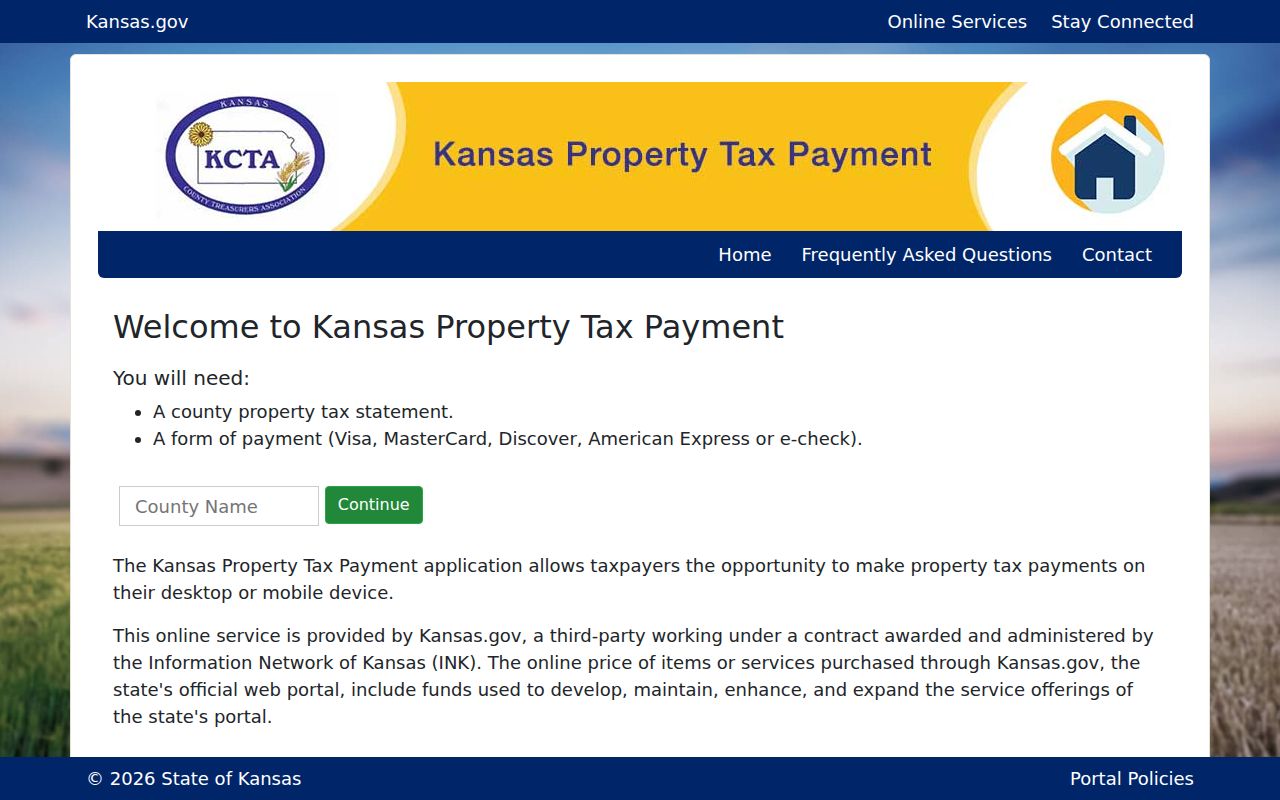
Keep the tax statement handy when paying. For anything deeper, ask the Treasurer for records by parcel, legal description, or tax year.
Request a Cheyenne County Tax Bill by Year
Start with an address. Ask the Appraiser first. Get the exact county account number and the legal description before requesting history. Then contact Treasurer Dawn Harper's office at 785-332-8810 and name each tax year you need. The office sits at 212 E Washington in St. Francis. It is open weekdays from 8:00 a.m. to 4:30 p.m.
- Ask the Appraiser to confirm the account number, legal description, tax year, class, and values.
- Give the Treasurer that identifier and request the bill, receipts, balance, and delinquency status for named years.
- Ask the County Clerk for the matching roll, levies, special assessments, abatements, additions, or escapes.
- Use a Kansas Open Records Act request if the routine office request does not cover the needed history.
- Taxable value
- The value remaining after the applicable classification and exemption treatment.
- Mill rate or levy
- The rate applied per $1,000 of assessed value.
- Homestead relief
- A state relief program with eligibility, filing, and documentation rules, not a blanket parcel assumption.
- Delinquency
- An unpaid tax status that should be confirmed for the exact year.
Retrieve Older Cheyenne County Property Tax Records
The county publishes no historical coverage details for its tax statements or roll database. A precise written request should identify the owner if known, situs address, parcel or account number, legal description, and the tax-year range. Ask separately for bills, receipts, delinquency entries, tax abstracts, and levy sheets rather than requesting everything.
K.S.A. 45-218 requires action as soon as possible and by the end of the third business day, or an explanation of the delay. K.S.A. 45-219 permits actual costs and advance payment. Request an itemized estimate before ordering a long run.
Cheyenne County Exemptions and Kansas Relief Are Distinct
An exemption changes how property is taxed. Kansas also runs property-tax relief programs with separate eligibility and filing forms. Use the KDOR exemption list and current homestead forms. Then confirm how the county coded the parcel.
Never infer an exemption from the owner's age, occupancy, or a prior bill. Ask the Appraiser for the exemption field. The effective tax year matters too. For relief claims, follow current KDOR documentation and deadlines. The county tax record alone does not settle eligibility.
Trace Cheyenne County Delinquency Through Each Stage
Cheyenne County publishes no downloadable delinquency list or public history screen. Ask the Treasurer directly. Is the tax year paid, unpaid, or in redemption? If a court foreclosure is involved, search the Kansas Judicial Branch portal. Then inspect the District Court file for the petition, judgment, and sale confirmation.
A public notice is a lead, not a verdict. Confirm any deed or release with the Register of Deeds. That office records the land instrument. The Treasurer, District Court, and County Clerk each document a different stage.
The Kansas Calendar Controls a Cheyenne County Appeal
Kansas mails real-property valuation notices by March 1. The taxpayer then has 30 days from the mailing date to request an informal meeting with the county appraiser. After that decision is mailed, an appeal generally must reach the Small Claims and Expedited Hearings Division of the Board of Tax Appeals within 30 days.
Personal property runs on a different clock. Kansas guidance gives May 1 as the notice date and 15 days for an informal request. Use the date on the actual notice. Then check the current KDOR property-tax calendar.
Contest a Cheyenne County Assessment With Evidence
Act quickly once the valuation notice arrives. Call the Cheyenne County Appraiser and request the full parcel record, including the classification, the land value, the improvement value, and the reasoning behind the estimate. You need those details before you can argue. Strong evidence might be a recent appraisal, photographs, contractor repair estimates, or comparable sales from the area. For an income-producing parcel, income data helps. Proof that the record lists the wrong property characteristics also counts.
Kansas offers a separate payment-under-protest route with its own deadlines and forms. It cannot serve as a second appeal of the same year's valuation once another appeal path has run. Check the current KDOR guide and ask the county which filing method applies before the deadline passes.
Watch the notice date. The ordinary real-property informal appeal window is 30 days from mailing; use the actual notice and current Kansas instructions.